Makrodefinicje: cube | tower |
wall | pyramid | contour
Poprzednie wersje: oldtower | oldwall |
oldpyramid
Makrodefinicje pomocnicze: rideside | leftside |
topside
Bryły budowane są z takich prostopadłościanów:
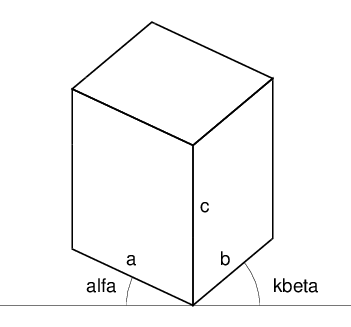
\input{edge}a = 0.75 b = 0.95 c = 1.1 alfa = 25° kbeta = 13°
document), np. tak:
\edef\b{0.8}\update
wall, pyramid, oldwall i
oldpyramid.
contour ustala się argumentami makrodefinicji. Kolor krawędzi
dla pozostałych makrodefinicji można zmienić tak:
\edef\linecolor{«nazwa_koloru»}alfa i kbeta są dodatnie. Gdy jeden z kątów jest równy zero a drugi jest dodatni, to
wspomniany punkt jest jednym z najniżej położonych punktów. Domyślności czytającego pozostawiam ustalenie którym konkretnie. Jeśli
co najmniej jeden z kątów alfa, kbeta jest ujemny, wspomniany punkt nie jest najniższy,
Makrodefinicja cube ma pięć argumentów. Pierwsze dwa argumenty to współrzędne punktu $P$, kolejne trzy to kolory
ścian: górnej, prawej i lewej.
\cube{2}{2}{green}{blue!40!white}{red}
\edef\linecolor{white}
\cube{4}{2}{blue!10!white}{blue!40!white}{blue!10!white}
\edef\alfa{0}
\cube{6}{2}{green}{blue!40!white}{red}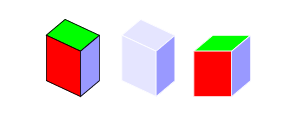
Makrodefinicja tower ma sześć argumentów. Pierwsze dwa argumenty to współrzędne punktu $P$, trzeci argument to
ciąg liczb – wysokości (w prostopadłościanach) na których znajdują się kostki tworzące wieżę, kolejne trzy to kolory ścian:
górnej, prawej i lewej.
\tower{2}{2}{{1,3,5}}{blue!40!white}{blue!10!white}{blue!10!white}
\tower{4}{2}{{0,2,4}}{blue!40!white}{blue!10!white}{blue!10!white}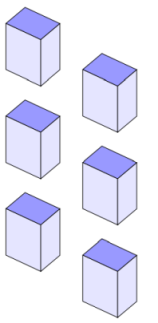
Makrodefinicja wall ma sześć argumentów. Pierwsze dwa argumenty to współrzędne punktu $P$, trzeci argument
opisuje wieże (tower) – od lewej do prawej – tworzące mur, kolejne trzy to kolory ścian: górnej, prawej i lewej.
Postać trzeciego argumentu:
(w1,w2,…,wn)
\wall{2}{2}{{{1,3,5},{0,1,2,3}}}{blue!10!white}{blue!40!white}{blue!10!white}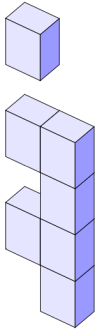
Makrodefinicja pyramid ma sześć argumentów. Pierwsze dwa argumenty to współrzędne punktu $P$, trzeci argument
opisuje prawe mury (wall) tworzące piramidę – na poniższym rysunku prawe są mury z czerwoną boczną ścianą; kolejne trzy to
kolory ścian: górnej, prawej i lewej.
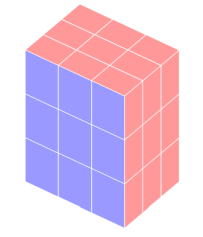
Postać trzeciego argumentu:
{mur1,mur2,…,murn}
\pyramid{2}{2}{{{1,3,4},{0,1,2,3}},{{1,3,4},{0,1,2,3}},{{1,3,4},{1,2}}}{blue!10!white}{blue!40!white}{blue!10!white}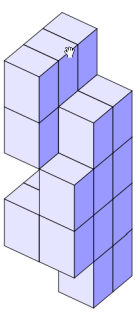
Makrodefinicja contour rysuje – linią przerywaną o szerokości 0,2 mm – krawędzie prostopadłościanu.
Ma ona sześć argumentów. Pierwsze dwa argumenty to współrzędne punktu $P$, kolejne trzy to wymiary prostopadłościanu, wymiary
podajemy jako wielokrotności $a,\,b,\,c$. Szósty argument to kolor.
\contour{2}{2}{4}{3}{2}{red}
\contour{7}{2}{1}{1}{1}{red}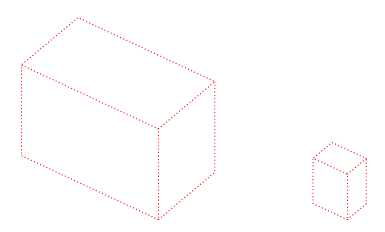
Makrodefinicja oldtower ma siedem argumentów. Pierwsze dwa argumenty to współrzędne punktu $P$, trzeci argument to wysokość wieży
(w prostopadłościanach), kolejne trzy to kolory ścian: górnej, prawej i lewej. Siódmy argument to liczba „pustych” prostopadłościanów
na dole wieży.
\oldtower{2}{2}{3}{blue!10!white}{blue!40!white}{blue!10!white}{0}
\oldtower{4}{2}{3}{blue!10!white}{blue!40!white}{blue!10!white}{0}
\oldtower{4}{2}{2}{green}{blue!40!white}{red}{3}
\edef\kbeta{0}
\oldtower{6}{2}{3}{blue!10!white}{blue!40!white}{blue!10!white}{1}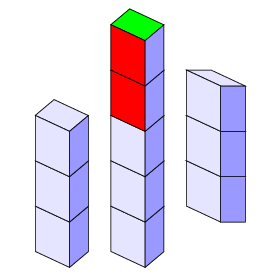
Makrodefinicja oldwall ma sześć argumentów. Pierwsze dwa argumenty to współrzędne punktu $P$, trzeci argument opisuje wieże
(othertower) – od lewej do prawej – tworzące mur, kolejne trzy to kolory ścian: górnej, prawej i lewej.
Postać trzeciego argumentu:
{w1/l1,w2/l2,…,wn/ln}
\oldwall{2}{2}{{3/0,2/0,3/1}}{blue!10!white}{blue!40!white}{blue!10!white}
\oldwall{6}{2}{{2/1,2/0,3/1}}{blue!10!white}{green!40!white}{green!10!white}
\edef\kbeta{10}
\update
\oldwall{10}{2}{{2/1,2/0,3/1}}{blue!10!white}{green!40!white}{green!10!white}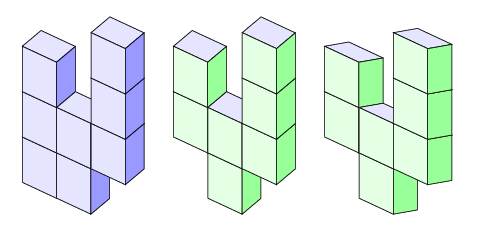
Makrodefinicja oldpyramid ma sześć argumentów. Pierwsze dwa argumenty to współrzędne punktu $P$, trzeci argument opisuje prawe mury
(oldwall) tworzące piramidę – na poniższym rysunku prawe są mury z czerwoną boczną ścianą; kolejne trzy to kolory ścian: górnej, prawej i
lewej.
Postać trzeciego argumentu:
{mur1,mur2,…,murn}
\edef\linecolor{red}
\oldpyramid{2}{2}{{3/0,3/0,2/0},{3/0,1/0,3/0},{1/0,3/0,1/1}}{blue!40!white}{blue!10!white}{blue!10!white}
\contour{2}{2}{3}{3}{3}{green}
\oldpyramid{7}{2}{{3/0},{3/0}}{blue!40!white}{blue!10!white}{blue!10!white}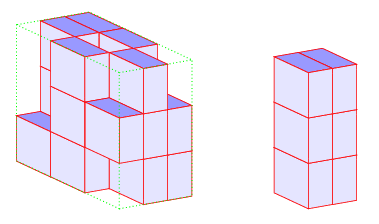
Makrodefinicja rightside ma trzy argumenty. Pierwsze dwa argumenty to współrzędne najniższego punktu, trzeci argument to kolor.
\rightside{2}{2}{red!50!white}
\edef\kbeta{60}
\edef\b{1}
\rightside{4}{3}{red!50!blue}
\edef\kbeta{-60}
\rightside{6}{3}{red!50!blue}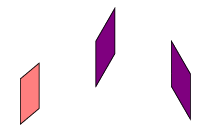
Makrodefinicja leftside ma trzy argumenty. Pierwsze dwa argumenty to współrzędne najniższego punktu, trzeci argument to kolor.
\leftside{2}{2}{red!50!white}
\edef\alfa{45}
\edef\c{2}
\leftside{4}{3}{red!50!green}
\edef\alfa{-45}
\leftside{6}{3}{red!50!blue}}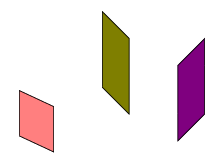
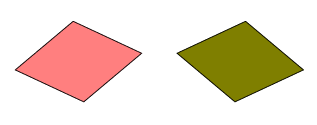
Makrodefinicja topside ma trzy argumenty. Pierwsze dwa argumenty to współrzędne najniższego punktu, trzeci argument to kolor.
\edef\a{2}
\edef\b{2}
\topside{2}{2}{red!50!white}
\edef\alfa {40}
\edef\kbeta{25}
\topside{6}{2}{red!50!green}